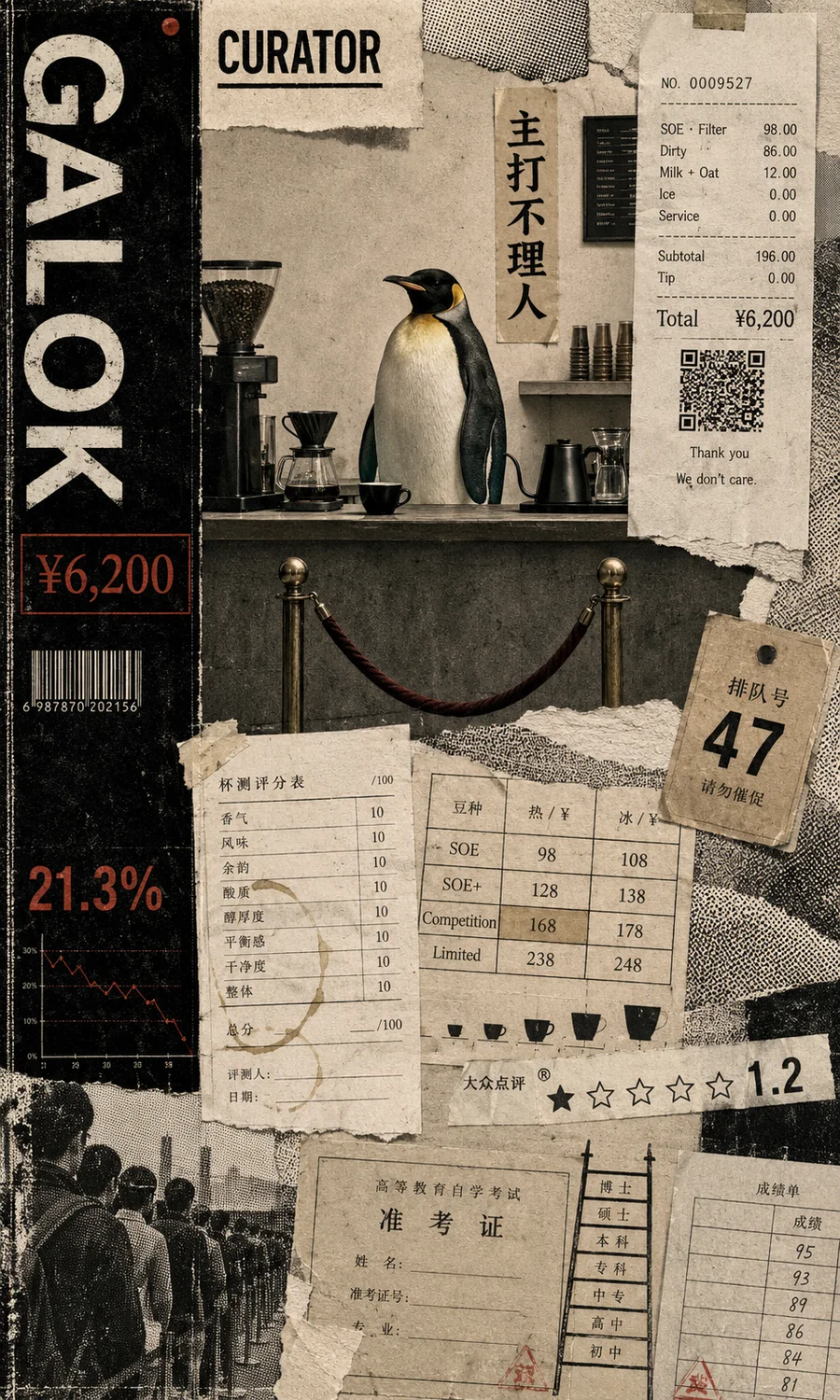
01 / THE PUNCHLINE
A business model died in real time.
In August 2025, a short video did something that years of trend pieces had not: it compressed an entire boutique economy into one painfully legible joke.
The clip follows an actor playing a customer who wanders into a coffee shop. The owner — China's now-infamous zhǔlǐrén, or “curator” — and his friends greet the intruder with a wall of silent stares. When service finally arrives, it comes wrapped in condescension: an Americano is re-narrated as a single-origin, cold-fermented Panama Geisha, delivered with the vocabulary of a sommelier and the warmth of a bouncer.
The video cleared 900,000 likes within days, according to Chinese outlets that covered its spread, and spawned a genre of parody.1 It also minted a pun that stuck: zhǔlǐrén, “the one in charge,” became zhǔ dǎ bù lǐ rén — “specializes in ignoring people.”
Eighteen months earlier, being a curator was aspirational. Now it was a punchline.
Understanding how a title went from status symbol to slur — and why the backlash was this vicious — says less about coffee than about what happens when a generation raised on meritocracy finally gets to hold the scorecard.
Evidence / four scales
What each number can actually tell us
Select a reported figure to separate signal from interpretation.
900,000 likes measures the parody's circulation. It shows resonance, not the size of China's boutique-café market.
02 / HOW THE CURATOR WAS BORN
When the chain owns the product, the independent shop sells a biography.
The term arrived secondhand, filtered through Japanese streetwear and creative-director culture before landing in Chinese fashion, design, and food-and-beverage scenes.2 Its promise was differentiation in a market Starbucks and Luckin had already flattened: once a chain could put a passable latte on every corner, the only thing left to sell was a story — provenance, philosophy, taste.
By the time the backlash hit, curator-run shops made up roughly half of the listings on Dianping's most-visited café rankings, according to an industry analysis published by Tencent News and Huxiu.3 An owner's biography, aesthetic, and personal mythology were not marketing around the product; they were the product.
03 / HOW IT DIED
The story survived. The service underneath it did not.
What broke was not the concept — it was the gap between the story and the service. Chinese social media compiled the offences into something close to a genre, documented by lifestyle and trade outlets: bathrooms reserved for members only, photography banned to “protect the atmosphere,” walk-ins turned away for lack of a reservation, regulars given warm smiles while strangers were made to feel they should be grateful just to be served.4
The mockery escalated into self-parody: delivery riders rebranding as “urban logistics curators,” street vendors as “gluten-free crêpe curators.” Once anyone selling anything could claim the title, its actual content — taste, discernment, authority — evaporated.
Commentators reached for an old reference to describe the wreckage: the curator as a “cyberpunk Kong Yiji,” the Lu Xun character who clings to the vocabulary and posture of the scholar-gentry long after his social standing has collapsed, unable to let go of a status he no longer occupies.5
04 / THE PRICE TEST
A listed price gave resentment a concrete target.
In November 2023, Genben Coffee, newly opened in Shanghai's Zhangyuan complex on Nanjing West Road, put a hand-poured coffee on the menu for 6,200 yuan — roughly $850 at the time. The Paper confirmed the list price and reported that no one had bought it when its reporter visited.6
The coffee was brewed from a prize-winning Panama Geisha bean whose raw cost was reported near 1,700 yuan per cup. It went viral within days. By January 2024, local reporting found the shop closed, its equipment removed and its phone disconnected.7 One line of commentary captured the mood better than any headline: the shop had tried to sort its customers into tiers, and the customers returned the favour by sorting it out of business.
This was not purely a meme cycle. Casualties showed up on balance sheets too. Restaurant-industry reporting counted around seventy Seesaw closures during 2024 and described tracker snapshots in which the chain fell from roughly 100 locations to just over 50, alongside layoffs and unpaid-wage disputes reported by staff.8
05 / THE MERITOCRACY HANGOVER
The credential ladder cracked. Competitive energy relocated.
The timing is not incidental. In June 2023, unemployment among urban youth aged 16–24 reached 21.3% under China's then-current survey series.9 The National Bureau of Statistics later resumed age-specific publication under a revised methodology that excludes students, making the new series narrower and not directly comparable with the old one.10
When the traditional route — good school, good firm, steady promotion — stopped delivering on its promise, some of that competitive energy did not disappear. It relocated.
Chinese coverage of the curator boom is full of one recurring character: the former big-tech employee turned café owner. One profile followed a former programmer at a Beijing technology company who left, spent time designing in Yunnan, and eventually opened a community-style coffee shop in Chengdu — the kind of biography curator cafés turned into a selling point rather than a footnote.3
A widely cited 2023 analysis of Xiaohongshu content found that “independent café owner” had become the platform's second most popular self-described identity, trailing only “big-tech employee.”11 The prestige of the old employer did not disappear when people left it. It was repackaged as the new venture's founding myth — the same credential logic, wearing an apron.
Michael Sandel's critique of merit-based hierarchy — published in Chinese translation as The Tyranny of Merit — argues that meritocratic systems do not just sort winners from losers; they trap the anxious near-elite in a permanent contest to prove they still belong.12 Pierre Bourdieu named the underlying mechanism decades earlier: taste functions as a coded class marker, and connoisseurship is a way of pulling the ladder up once one has climbed it.
The curator economy fused both. Told they could no longer distinguish themselves through a job title, the newly self-employed reached for the other currency still available to them — discernment, vocabulary, story — and started gatekeeping with it instead.
06 / THE PUBLIC SCORECARD
The people taking the status test got to write one back.
A generation that spent its adolescence being sorted by exam scores and its twenties being sorted by employer prestige found a hierarchy it was allowed to reject outright, rather than lose at quietly.
Read that way, the backlash was not really about bad service or overpriced espresso. It was the rare moment when the people usually on the receiving end of a status test got to administer one instead — and failed the curators publicly, gleefully, at scale.
The curator economy promised an escape from meritocratic competition. What it actually built was a smaller, more petty version of the same game — one where the entry fee was a vocabulary lesson instead of a diploma.
The public did not just get tired of paying it. They enjoyed, for once, being the ones who got to say no.
Galok is a personal magazine of economic observation and city memory. This essay distinguishes reported figures from interpretation; links and dates are listed below.
SOURCES / REPORTED AND READ
A source ledger, not a decorative bibliography.
- People's Daily / People App, “How did the word ‘curator’ overturn?”, August 2025; cross-checked with China.com, 1 September 2025.
- The World of Chinese, “Why Gen Z Is Turning Against Curator Cafés in China,” 17 October 2025.
- Tencent News / Huxiu, “Who did curator coffee offend?”, 24 September 2025.
- Winshang, “Curator coffee faces online ridicule,” 2 August 2025; 36Kr, “Curator restaurants keep opening, but young people are not buying,” 19 August 2025.
- Tencent News, “The curator faces online ridicule,” 2 August 2025.
- The Paper, “Shanghai sees a RMB 6,200 cup of coffee,” 11 November 2023.
- Zhejiang Online, “RMB 6,200-a-cup coffee shop closes in under three months,” 17 January 2024.
- Canyin88 / Yilan Business, “Closures, layoffs and founder restrictions: Seesaw at the edge,” 22 January 2025, citing Zhaimen Canyan and Yilan Business location data.
- National Development and Reform Commission, response citing NBS spokesperson Fu Linghui, 8 August 2023.
- National Bureau of Statistics, methodology note on age-specific surveyed unemployment rates, 17 January 2024.
- Sohu, “Big-tech workers quit to open shops — Xiaohongshu's most popular persona?”, 16 June 2023.
- The Paper, discussion of Michael Sandel's The Tyranny of Merit, 24 August 2024; Pierre Bourdieu, Distinction, 1979.