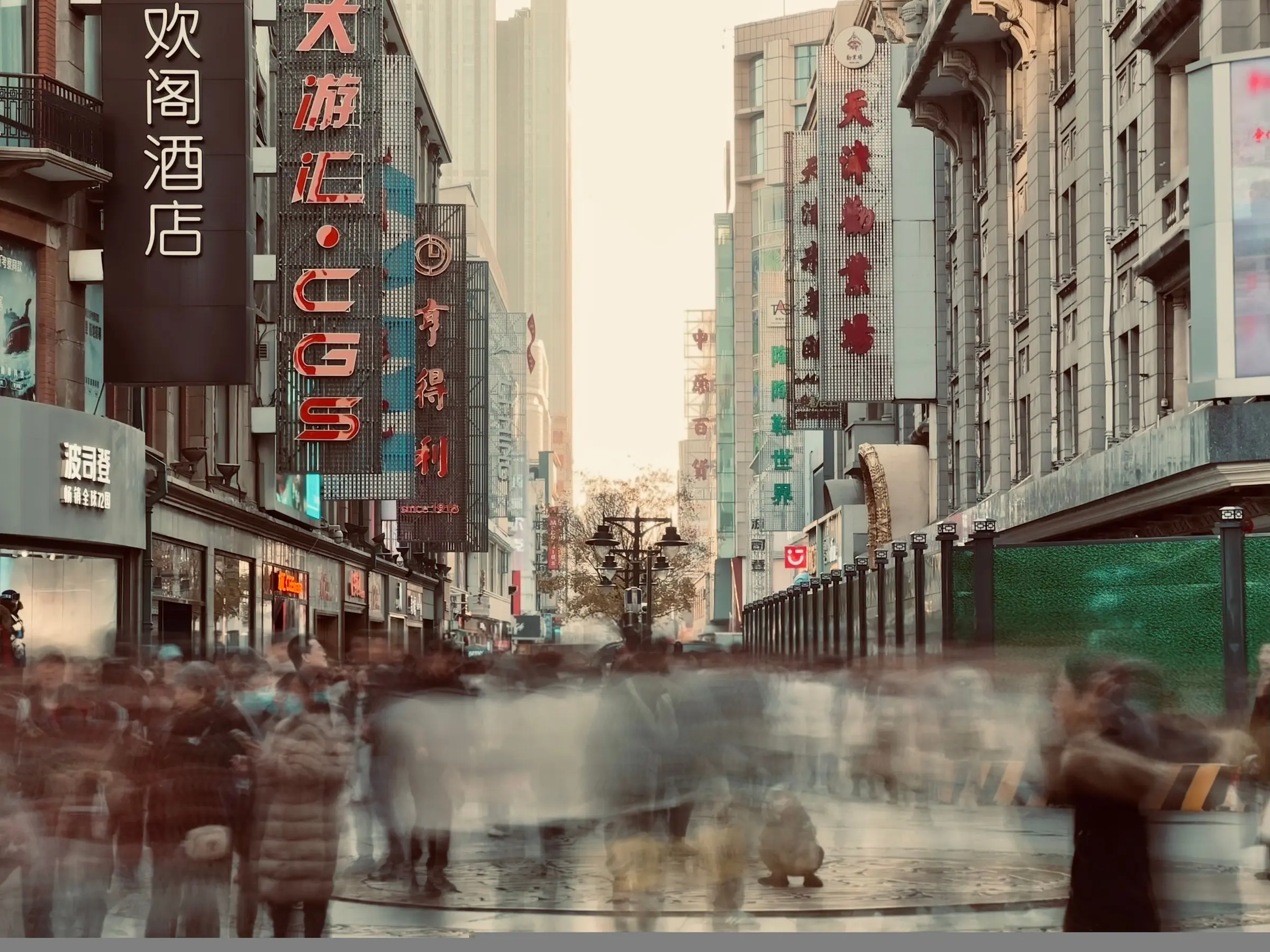
01 / TWO TOURISMS
The inbound boom and the domestic production line occupy the same country.
A Spanish tourist told a reporter this spring that in Europe she worries about strikes and cancelled flights. In China, “everything just works” — even the subway announces itself in English.
A Polish visitor in Nanjing said the same thing in different words: it was his first trip to China, and it felt convenient. These are not isolated impressions. In 2025, China recorded over 82 million inbound and outbound crossings by foreign visitors, a 26.4% jump from the year before — three out of every four entering visa-free. During this year’s Spring Festival, foreign arrivals hit 1.31 million, up almost 22% year over year. Shanghai’s freelance interpreters were charging 2,500 yuan a day for Russian or Spanish and still couldn’t keep up with demand.
By every official metric, this is a triumph. Visa-free corridors have widened, tax-refund counters have gotten faster, and a tourist can now go from a ski slope in Liaoning to an electronics market in Shenzhen to an exit stamp in Hong Kong without friction. The infrastructure is real. The hospitality is mostly real too.
But ask a domestic traveler — someone who has done the 8-hour drive to a “secret” canyon advertised on Xiaohongshu, has stood in a two-hour queue to take a 90-second photo, has paid 30 yuan to use a toilet at a site that was supposed to be free — and you get a different story. Not a contradiction of the inbound-tourism boom, but its shadow. China’s domestic tourism economy has been quietly restructured by the platform layer sitting on top of it, and the result looks less like leisure and more like a production line: standardized inputs, standardized outputs, a queue at every station.
Here is the asymmetry worth sitting with. The foreign tourist arriving today is, structurally, protected from the worst of this. They are often guided, often there for a festival or a landmark with built-in cultural weight — the Great Wall, the Terracotta Army, a Lunar New Year lantern fair — and increasingly steered toward what the industry itself calls a shift “from check-in to immersion.” Tour operators have started selling “panda keeper for a day” experiences instead of zoo walkthroughs, precisely because the old check-in model stopped being interesting even to the people designing it.
The domestic tourist, especially the one taking cues from short-video platforms, is operating inside the system the panda-keeper experience was invented to escape. They are the target market for the other tourism economy — the one built not around a place, but around a fifteen-second clip of a place.
Observe / two products
The same country, two tourism logics
Switch lenses to compare how the essay describes the visitor journey.
Inbound / Often guided, anchored by festivals or culturally weighted landmarks, and increasingly sold as participatory immersion.
Observe / complaint pipeline
The four-stage complaint cycle
Select a station to see how one disappointing visit becomes a national talking point.
01 / On-site disappointment: the visitor arrives to queues, overcrowding or a let-down.
02 / THE COMPLAINT CYCLE
The repetition has its own vocabulary.
A 2026 industry report on scenic-area complaints describes something close to an assembly line in the literal sense: a standardized pipeline that now runs in the same four steps almost every time.
- On-site disappointment. A visitor arrives at a site promoted online and encounters long queues, overcrowding, or a let-down.
- Short-video exposure. They film it and post — on Douyin, on Xiaohongshu.
- Emotional resonance. Comment sections fill with “me too,” “same experience,” “avoid this place” (避雷).
- Cross-platform amplification. News aggregators and content accounts repost the footage, and a local service complaint becomes a national talking point.
This cycle is now so well-worn that monitoring firms track it as a category of its own, with its own vocabulary: 照骗 (“photo deception” — image versus reality), 避雷 (“dodge the landmine” — a warning post), and 价格刺客 (“price assassin” — an unexpected, inflated charge). The cycle has a name precisely because it repeats with very little variation, site after site, season after season.
03 / THE MECHANICS OF 照骗
The photograph became both the starting point and the destination.
The Xiaohongshu “filter scenery” controversy from a few years back remains the clearest case study, and the pattern it exposed hasn’t gone away. A scholar interviewed on the episode put it simply: when a good photo becomes the starting point and the destination of a trip, the deeper value of a place — its nature, its history, its culture — gets buried under a surface that was never meant to be load-bearing. Bloggers post travel photography without labeling it as styled photography; visitors arrive treating it as a literal guide; the gap between the two produces what one commentator called the experience of being cheated.
What makes this hard to regulate is also what makes it durable: it is extremely difficult to prove a blogger and a venue have a paid arrangement, so consumer-protection law struggles to reach it. The incentive structure does the regulatory work that law cannot. A viral location post can be worth tens of thousands of yuan to its creator. Whether the visitor who follows it is satisfied or disappointed is, for the creator, simply not the relevant variable.
The result is a genre of location that exists almost entirely as image. A Henan “sky ladder” attraction went viral on Douyin for the gap between its promotional footage — empty, cinematic, golden hour — and the reality: a grey day, a crowded queue, a string of creators reciting near-identical lines to camera in front of a site that, in their videos, always appeared deserted. The location is the same. The lighting, the script, and the absence of other people are manufactured.
04 / WHEN THE CROWD IS THE PRODUCT
Virality produces the crowd that destroys the promised scene.
The deeper irony is that virality and ruined-ness are not opposing outcomes — they are sequential ones. A site goes viral because it photographs as serene and exclusive. The virality then produces the crowd that makes it neither. Chaka Salt Lake, one of the earliest and most successful cases, went from regional curiosity to national 4A-rated attraction: 2.5 million visitors in 2017, climbing to over 3.37 million the following year — sixty-one times its 2012 footfall. Every imitator since has chased the same arc, and most of them, lacking the underlying geography that made the original photogenic, fake it instead: heavy editing, AI-smoothed “hero shots” sold as travel guidance rather than studio work. A safety report this spring noted the same trick spreading into extreme-sports tourism — AI-composited “epic” photos from high-risk outdoor activities, marketed to draw in visitors who then take on real physical risk chasing an image that was synthesized after the fact.
This is the part of “来都来了” (we’ve already come this far, may as well) that deserves unpacking culturally rather than dismissing as irrationality. It is not, primarily, sunk-cost thinking. It is closer to a social contract: the trip was booked, the group chat was told, the photo was promised before it was taken. Backing out at the site — even a disappointing one — costs more social currency than seeing it through and posting something that makes the disappointment invisible. The phrase absorbs the gap between expectation and reality so the traveler doesn’t have to.
Observe / Chaka Salt Lake
Virality translated into footfall
Select a marker to read the reported scale without flattening the time periods.
2017 / Chaka Salt Lake received 2.5 million visitors.
05 / HOMOGENIZATION
The assembly line produces identical content about different landscapes.
The complaint pipeline above flags four recurring failure modes — gap between promotion and reality, excessive filtering, photo queues, over-commercialization — and a fifth has emerged more recently: manufactured “intimacy” with costumed performers. In Jiangxi this spring, a resort’s costumed NPC interactions — candy fed mouth-to-mouth, staged near-kisses — went viral, drove a short-term spike in visitors, and then drew a public rebuke from People’s Daily for letting cultural performance slide into something cheaper, chasing “emotional value” and photo ops at the expense of the cultural transmission the role was supposed to provide.
What connects the filter scandal, the sky-ladder complaints, and the NPC controversy is the same underlying production logic: a site’s success is measured by its photographability and clip-worthiness, not by what it was originally for. Once that becomes the metric, every operator is incentivized to converge on whatever format already works — the same poses, the same captions, the same “no one else here” framing, the same manufactured intimacy — because differentiation is riskier than imitation. The assembly line doesn’t produce identical landscapes. It produces identical content about landscapes, and the landscapes get reshaped to fit.
06 / A COUNTY-LEVEL FOOTNOTE
The mechanism no longer needs a famous destination.
The newest twist is geographic. Industry monitoring through 2026 shows complaint patterns spreading into county-level tourism — the “hidden gem small city” wave that follows the Zibo-barbecue, Harbin-snow playbook. The mechanism is identical, just smaller-scale and faster: a county goes viral, traffic and hotel capacity buckle under sudden demand, and the same vocabulary — 照骗, 避雷, 价格刺客 — gets applied within hours of the first complaint video. The assembly line doesn’t require a famous destination anymore. It just requires an algorithm willing to push the clip.
07 / WHAT THE INBOUND BOOM REVEALS
Immersion is the industry’s diagnosis of its own checklist problem.
This is why the inbound-tourism numbers are worth holding next to the domestic complaint cycle rather than treating as an unrelated success story. The industry’s own diagnosis of what foreign tourists want — unhurried, participatory, oriented around lived culture rather than a checklist — is implicitly a diagnosis of what’s gone wrong with the domestic product. Operators are not redesigning inbound tourism out of idealism. They are redesigning it because the checklist model stopped converting, and a different customer base gave them room to try something else.
08 / WHAT IS UNDERNEATH
A filter lasts when it points at something with weight.
Xi’an’s Tang Paradise (⼤唐不夜城) is the example the industry itself reaches for as a counter-case: it began as a viral site like any other, but a tourism-association academic argued its staying power comes from the cultural weight of Xi’an underneath it — not the filter, but what the filter was pointed at. The implied conclusion, even from inside the industry, is uncomfortable: most “⽹红” sites have no underneath. The filter is the product, which is exactly why it has a shelf life measured in one viral cycle and not much longer.
Galok View covers Chinese consumer culture and platform economics for a Western audience, using the analytical framework 势·框·察 (Macro · Frame · Scene).